
A removable eBike battery unclips from the frame so you can carry it inside and charge it anywhere there is an outlet. A fixed battery stays built into the frame, so the whole bike has to be parked next to a power source to charge. That one difference is what actually changes for a daily rider, not the capacity number printed on the spec sheet.
This guide compares removable vs. fixed eBike batteries on the things that matter for daily use: charging convenience, weight and ride feel, security, replacement cost, and long-term durability. If you already know you want a swappable battery and just need model options, NINE09's guide to the best eBikes with removable batteries in 2026 ranks current choices. This article is for the step before that: deciding whether swappable is the right architecture for you in the first place.
A removable eBike battery gives you more charging flexibility, easier replacement, and the option to carry a spare battery. A fixed battery offers a more integrated design with fewer removable components. The right choice depends mainly on where you park, how you charge, and how you use your eBike.
Removable and Fixed Batteries, Defined
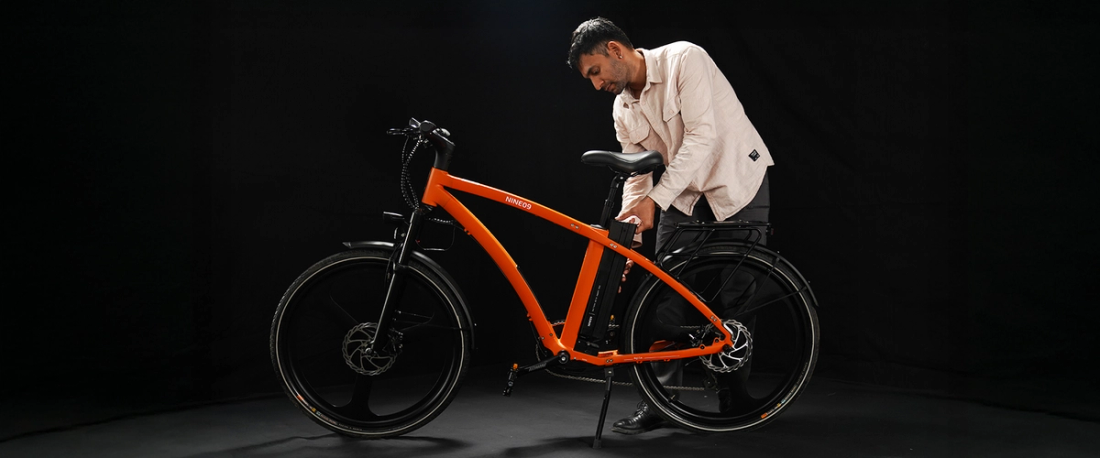
- **Removable (swappable) battery:**A battery pack that locks into the frame with a connector and release mechanism, and can be taken out by hand without tools. It charges off the bike, on a desk, counter, or shelf, and some riders keep a second pack for backup range.
- **Fixed (integrated) battery:**A battery pack built into the frame tube or permanently mounted to it. It is not designed to come off during normal use. The bike charges in place, usually with a charging port on the frame.
Both architectures use similar lithium-ion cell chemistry inside. The difference is mechanical and logistical, not electrochemical.
Removable vs Fixed eBike Battery: Quick Comparison
- Factore · Removable (Swappable) Battery · Fixed (Integrated) Battery
- Where you can charge · Anywhere with an outlet, battery carried indoors · Only where the bike itself is parked
- Backup range · A second battery can be carried and swapped mid-ride · Not possible without an external power bank, if supported
- Theft exposure · Battery can be removed and taken inside separately from the bike · Battery stays on the bike, protected only by whatever lock secures the frame
- Weight distribution · Battery mass sits wherever the mount point is designed, plus connector hardware · Often lower and more centered, since there is no separate housing or release mechanism
- Replacement · Usually swapped in or out without frame disassembly · May require a service visit, since the pack is built into the frame
- Exposure at the connection point · Needs a sealed, weatherproofed connector since it disconnects regularly · Fewer exposed contact points, since it is sealed once at manufacture
Charging Convenience: Where You Actually Plug In
This is the factor that affects daily riders the most, and it comes down to where you live and park.
If you live in an apartment, share a building entrance, or park outdoors at work without access to an outlet, a removable battery solves a real logistics problem: you carry the pack inside and charge it at your desk or by the door, instead of needing the whole bike next to a socket. NINE09's guide on charging an eBike battery safely covers this in more detail, including how to charge a swappable pack indoors without a garage.
A fixed battery is not necessarily inconvenient if you have guaranteed access to a plug near where you park, such as a private garage or a reserved spot with an outlet. In that case, the extra step of removing and carrying a battery adds no benefit.
Weight, Balance, and Ride Feel
A removable battery needs a release mechanism, a sealed connector, and a housing that can be pulled or slid out. That hardware adds a small amount of weight and, depending on the mount location, can sit slightly higher or lower on the frame than a permanently bonded fixed pack.
In practice, the difference in ride feel between a well-designed swappable system and a fixed one is small for most commuting speeds and distances. It becomes more noticeable on cargo-loaded rides or tighter, technical handling, where a lower, more centered mass helps. For a typical urban commute, this factor matters less than charging convenience or security.
Security: What Happens When You Park Outside
Removing the battery when you lock up outdoors reduces what a thief can do with the bike and adds a layer of protection beyond the frame lock itself, though it does not replace a proper lock. The battery can be taken inside separately while the bike stays secured by its physical and electronic anti-theft features. For a fuller look at protecting a parked eBike, see how GPS tracking and anti-theft features protect your eBike.
A fixed battery stays with the bike when it is parked, so security depends entirely on the bike's physical and electronic anti-theft features, such as the frame lock, an electronic immobilizer, or GPS tracking. That is not automatically worse, but it does mean all of your security relies on one layer of protection instead of two.
Cost, Replacement, and Availability
Over the life of an eBike, batteries degrade and eventually need replacing. A removable battery is generally simpler to replace, since a new or refurbished pack can usually be swapped in without opening the frame or visiting a service center. This also makes it easier to carry a spare for longer rides, at the cost of buying a second pack.
A fixed battery replacement more often requires a technician, since the pack is built into the frame. This can mean more downtime and a service visit, though it also means one fewer connector and mechanism that can wear out over years of daily removal and reattachment.
Maintenance and Long-Term Durability
Every connect-and-disconnect cycle on a removable battery is a small amount of mechanical wear on the connector and release latch. A well-sealed system, rated for daily use, handles this without issue over years of ownership. A poorly sealed one can develop connection problems or reduced water resistance over time.
A fixed battery avoids that specific wear point, since it is never removed, but it also cannot be inspected or serviced as easily if something inside the pack does fail.
For either architecture, a battery management system that actively monitors cell health, temperature, and charge cycles matters more for long-term reliability than the removable-vs-fixed choice on its own.
Which One Actually Fits Your Daily Commute?
Use this checklist to decide:
**Can you park within reach of a plug every time you charge?**If not, a removable battery solves that problem directly.
**Do you want a backup battery for longer routes or multi-stop days?**Only a removable battery makes that possible.
**Do you regularly park outdoors, away from your home or office?**A removable battery lets you take the power source inside, adding a real security layer.
**Is minimal maintenance and zero connector wear your top priority, and do you always have charging access at the bike itself?**A fixed battery removes one moving part from the equation.
For most daily commuters, especially those in apartments, shared buildings, or offices without dedicated bike charging, the removable battery answers more of these questions in their favor.
How NINE09 Approaches This
NINE09's CX01 and CX02 both use a 10.4Ah, 374Wh swappable lithium-ion battery pack rated IPX7 for water resistance, managed by a Smart BMS that tracks battery health over time. The battery is designed to be removed for indoor charging without needing frame access or tools.
The two models share this same battery architecture and differ mainly in frame geometry: the CX01 uses a Step Over frame, while the CX02 uses a Step Through frame that makes mounting and dismounting easier for riders who prefer it. Neither model changes how the swappable battery itself works.
Common Mistakes When Choosing Between the Two
- **Assuming fixed always means lighter.**The difference is often marginal and depends on the specific design, not the category.
- **Assuming removable always means less durable.**A well-sealed connector rated for daily use is built for exactly that.
- **Ignoring where you will actually charge.**The single biggest factor is whether you have guaranteed plug access at the bike itself.
- **Not checking the battery's water resistance rating.**A removable pack that disconnects regularly needs a proper IP rating to hold up to rain and daily handling.
- **Comparing only the capacity number.**A larger fixed battery is not automatically more useful than a smaller removable one if you cannot charge it where you park.
Choosing With Confidence
The removable-vs-fixed decision is really a question about your own routine: where you park, whether you have plug access, and how much you value being able to carry your power source inside. Once that's answered, comparing specific models becomes much easier, since you are only evaluating capacity, range, and features within the architecture that actually fits how you commute.
If a swappable battery fits your situation, the NINE09 CX02 is worth a closer look for riders who prefer a Step Through frame, while the CX01 suits riders who prefer a conventional Step Over design. Specifications reflect current NINE09 product pages and may change as models are updated. For questions about which model fits your specific commute, contact the NINE09 team.
Explore the NINE09 CX02, or contact the NINE09 team to talk through which battery architecture and frame fit your commute.
Frequently Asked Questions
What is the difference between a removable and fixed eBike battery?
A removable eBike battery can be detached from the bike and charged separately, while a fixed battery stays built into the bike and is normally charged while installed. The main practical difference is charging flexibility, not the underlying lithium-ion battery chemistry, which is similar in both.
Is a removable eBike battery better than a fixed one?
Neither is universally better. A removable battery is better if you cannot park next to a plug every time you charge, want a backup pack, or want to bring the battery inside for security. A fixed battery can work just as well if you always have guaranteed charging access at the bike itself.
Can you charge a removable eBike battery indoors?
Yes. That is the main advantage of a removable battery. You unclip the pack and charge it at a desk, counter, or by the door, instead of needing the whole bike next to an outlet. This is especially useful in apartments or shared buildings without dedicated bike charging.
Are fixed eBike batteries more secure than removable ones?
Not necessarily. A fixed battery stays attached to the bike when it is parked, so security depends entirely on the frame lock and any electronic anti-theft features. A removable battery can be taken inside separately, adding a layer of protection beyond the lock alone, though it does not replace a proper lock.
Do removable eBike batteries wear out faster than fixed batteries?
Not from the cell chemistry itself, since both use similar lithium-ion cells. The extra wear point on a removable battery is the connector and release mechanism, which is why a proper water-resistance rating and solid build quality matter for daily swapping.
Can you replace or upgrade a removable eBike battery later?
Usually, yes. A removable battery can generally be swapped for a new or replacement pack without frame disassembly. A fixed battery replacement more often needs a service visit, since the pack is built into the frame.
What battery does the NINE09 CX01 and CX02 use?
Both the NINE09 CX01 and CX02 use a 10.4Ah, 374Wh swappable lithium-ion battery rated IPX7 for water resistance, managed by a Smart BMS that monitors battery health. The two models share this battery architecture and differ mainly in frame style.
30. september 2026 | BATTERY CARE & CHARGING
Udskifteligt kontra fastmonteret e-cykelbatteri: Hvad betyder det egentlig for dem, der cykler dagligt?

16. september 2026 | eBike-teknologi
Sådan beskytter GPS-sporing og tyverisikringsfunktioner din e-cykel
8. september 2026 | eBike-teknologi