If you're buying or riding an e-bike in Europe, one of the first things to check is its legal speed limit, motor power, and rider requirements. While most European countries use a 25 km/h pedal-assistance limit for standard e-bikes, the rules for age, helmets, registration, licensing, insurance, and faster speed pedelecs vary by country.
This guide explains the ebike speed limit in Europe, the 250W/25 km/h framework behind it, age requirements by country, and the key differences between standard e-bikes and faster speed pedelecs.
In the EU, a standard pedal-assisted cycle that falls within the relevant exemption from vehicle type-approval generally has a maximum continuous rated motor power of 250W or less, with assistance that progressively reduces and cuts off before the vehicle reaches 25 km/h. National road-use rules, age requirements, equipment requirements, and rules for faster e-bikes differ from there.
What Is the eBike Speed Limit in Europe?
For a conventional European EPAC (Electrically Power Assisted Cycle), the assistance limit is 25 km/h.
Under EU Regulation 168/2013, pedal cycles with pedal assistance are excluded from that regulation's vehicle type-approval framework when they have an auxiliary electric motor with a maximum continuous rated power of 250W or less, the motor output cuts off when the rider stops pedalling, and assistance progressively reduces and cuts off before the vehicle reaches 25 km/h.
That 25 km/h figure refers to motor assistance, not the maximum physical speed of the bicycle. A rider can travel faster than 25 km/h under their own pedalling power or on a downhill; the point is that the motor stops providing regulated assistance above the cutoff.
The basic European framework
| Requirement | Standard EPAC framework |
|---|---|
| Motor power | Up to 250W maximum continuous rated power |
| Assistance cutoff | At or before 25 km/h, depending on the applicable rule |
| Pedal assistance | Motor assistance linked to pedalling |
| Classification | Generally treated as a bicycle where national requirements are met |
| Licence | Generally not required for a compliant standard EPAC, subject to national rules |
| Registration | Generally not required where treated as a bicycle |
| National variations | Age, helmet, equipment, and road-use rules can differ |
Don't confuse this EU regulatory framework with a single set of road rules that applies identically everywhere. Individual countries layer additional requirements on top of it.
Is 250W the Legal eBike Limit in Europe?
The frequently quoted 250W limit refers to maximum continuous rated power, not necessarily a motor's short-term peak output.
That distinction matters when comparing e-bike specifications. A manufacturer may advertise a headline wattage figure that reflects peak power rather than continuous rated power, and the two shouldn't be treated as equivalent for regulatory purposes. The EU exemption specifically refers to maximum continuous rated power of 250W or less, so when checking whether an e-bike fits the standard European framework, look past the headline number and check the manufacturer's technical documentation.
Does EN 15194 Make an eBike Legal Everywhere in Europe?
Not by itself. EN 15194 is a European technical standard covering electrically power assisted cycles and their safety requirements and test methods. Meeting a technical standard is a different thing from meeting the complete set of road-use laws applicable in a given country. The regulatory structure runs: EU legislation, then national legislation, then technical standards, then local road-use requirements. That distinction matters most when a bike is sold across multiple European markets.
eBike Speed Limits & Age Rules by Country
The table below covers the major markets. National rules can add further requirements around helmets, cycle paths, equipment, insurance, and specific vehicle categories, so treat this as a starting point rather than the complete picture for any one country.
| Country | Standard assistance limit | Minimum age (standard) | Speed pedelec (up to 45 km/h) |
|---|---|---|---|
| Germany | 25 km/h | No federal minimum; 14 is commonly recommended | Effectively 15 to 16+, since it requires an AM moped licence |
| France | 25 km/h | No strict national floor for a standard EAPC; 14 is widely cited in practice, and under-12s need adult supervision on public roads | 16+, with an AM licence or equivalent |
| Netherlands | 25 km/h | No legal minimum nationally (a handful of municipalities informally suggest 16) | 16+, AM moped licence |
| Belgium | 25 km/h | No minimum age for a standard 250W pedal-assist e-bike | Treated as a moped (Class P); minimum age 16 |
| Italy | 25 km/h | Widely cited as 14 for independent riding | Moped classification; licence required; helmet mandatory regardless of age |
| Spain | 25 km/h | Commonly cited as 15; helmet mandatory on interurban roads | L1e-B moped category; AM or B licence required |
| Austria | 25 km/h | No minimum to ride; helmet mandatory under 14 | Reclassified as a motor vehicle from October 2026: registration, plate, insurance, licence, and helmet required |
| Switzerland | 25 km/h (up to 500W, non-EU rules) | 14 minimum; ages 14 to 15 need a Category M licence; no licence needed from 16 | Category M licence required at every age, including adults |
| United Kingdom | 25 km/h / 15.5 mph, EAPC rules | 14 | Vehicles outside EAPC requirements are treated as mopeds or motorcycles: AM entitlement and DVLA registration required |
Sources: EU Regulation 168/2013, GOV.UK EAPC guidance, Belgian federal police guidance, Austria StVO amendment, BMIMI, Swiss e-bike rules, bfu.
Why the country differences matter
The 25 km/h assistance limit is used almost everywhere, but the legal detail around it isn't identical. Belgium is the clearest example: it defines three separate tiers (electric bicycle, motorised bicycle, speed pedelec) with different power caps, even though two of those tiers share the same 25 km/h top speed, and Belgian sources themselves don't agree on where the age minimum starts for the base tier. Looking at speed alone won't tell you which legal category a bike actually falls into, or what age applies to it.
Age rules for standard e-bikes are the least consistent part of this picture. Germany, the Netherlands, and Austria don't set a national minimum age for a compliant EPAC at all, leaving it to parental judgment. Italy and Spain lean toward a 14-year floor in practice. And age minimums and helmet rules are separate things worth checking independently of each other: Austria, for instance, has no riding-age minimum but does require a helmet for any e-bike rider under 14.
What Happens Above 25 km/h? Speed Pedelecs Explained
Once a bike’s motor assists past 25 km/h, commonly up to around 45 km/h, it stops being a bicycle in the eyes of the law almost everywhere in Europe. These "speed pedelecs" get folded into moped or light-motorcycle categories, which typically brings:
- A moped-class licence (AM category across most of the EU, Category M in Switzerland)
- Registration and a licence plate
- Compulsory third-party liability insurance
- An approved motorcycle-style helmet, not a standard bicycle helmet
- Restrictions on cycle-path access, since many countries push speed pedelecs onto the regular road
Age minimums also tighten considerably here, generally landing at 16 across France, the Netherlands, Belgium, and Switzerland, since the licence itself sets the floor. For Italy, widely cited as 14 for independent riding.
A speed pedelec is not simply a standard e-bike with the limiter removed. It's a distinct legal category in most countries, and it can require type approval, registration, insurance, a licence, and specific safety equipment on top of that.
Is a 350W eBike Legal in Europe?
It depends on what that 350W figure actually represents, and this is one of the most important details to check before buying.
Manufacturers use several different terms that get flattened into one headline number in marketing copy: continuous rated power, nominal power, peak power, and maximum motor output. These aren't interchangeable for regulatory purposes. The EU pedal-cycle exemption refers specifically to maximum continuous rated power of 250W or less. So if a manufacturer advertises 350W as peak output while the continuous rated power sits at or below the legal threshold, that's a different regulatory picture than a motor whose continuous rated power is genuinely 350W. Always check the manufacturer's technical documentation, not just the spec-sheet headline, and cross-reference it against the rules in the country where you'll ride.
What Happens If You Derestrict an eBike?
Removing or bypassing an e-bike's speed or power limiter can change its legal classification outright. A modified bike may no longer meet the requirements for a standard pedal-assisted bicycle. Italy, for example, treats modified pedal-assisted bicycles as mopeds, which brings registration, insurance, and licensing requirements with it. The UK takes the same approach: an electric bike that no longer meets EAPC requirements is reclassified as a moped or motorcycle. Derestricting isn't just a performance tweak. It carries legal, insurance, and road-use consequences.
Can You Ride an eBike Across European Borders?
A compliant standard e-bike is generally easier to take across borders than a speed pedelec or any other motor-vehicle-class e-bike, but cross-border travel doesn't mean every country applies identical road rules. Before crossing a border with an e-bike, it's worth checking each destination's rules on assistance speed, motor power classification, minimum rider age, helmets, cycle-path access, insurance, equipment, and registration or documentation, particularly for routes that touch non-EU countries like Switzerland or the UK.
25 km/h eBike vs. 45 km/h Speed Pedelec: Which Is Better for Commuting?
For most urban commuters, the standard 25 km/h e-bike is the simpler option: no driving licence in most markets, no vehicle registration where it's treated as a bicycle, broader access to cycling infrastructure, and lower regulatory complexity overall. A 45 km/h speed pedelec can make sense for longer commutes where the extra assisted speed genuinely saves time, but it comes bundled with the licensing, insurance, and equipment requirements described above. The right choice depends less on the speed number and more on where you ride, how far you commute, and which country's rules apply to that route.
What This Means for the NINE09 CX01 and CX02
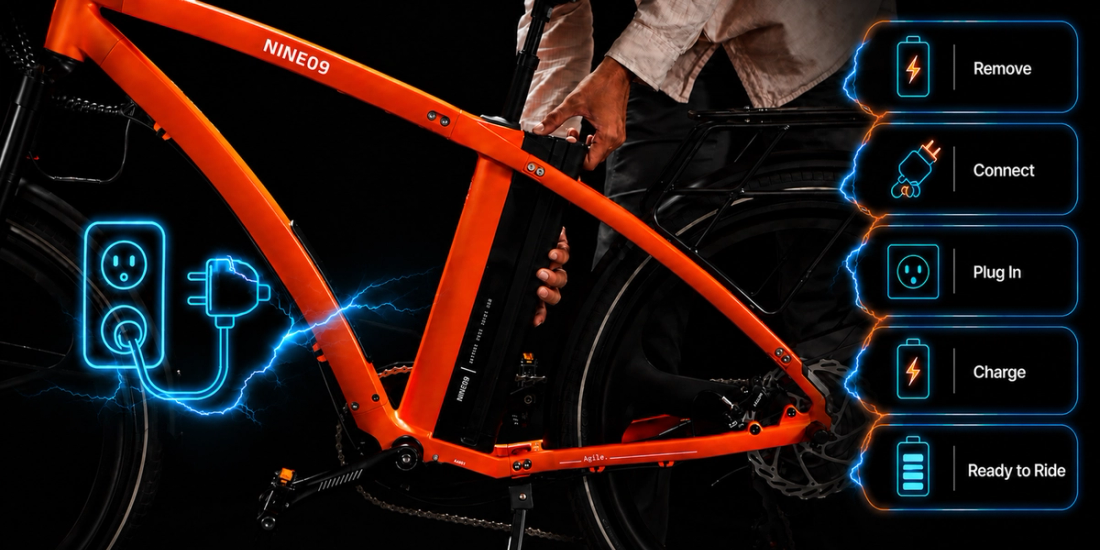
NINE09 builds the CX01 and CX02 for the standard EPAC category: pedal assistance capped at 25 km/h, no throttle, paired with a swappable battery pack (IPX7-rated, with an active Smart BMS) and the NINE09 app for GPS tracking, remote locking, and range estimation. NINE09 states that both models are designed to comply with the EU pedelec framework for motor-assisted riding up to 25 km/h. Where the bikes meet the applicable national requirements for EPACs, they can be used under the rules applicable to standard bicycles.
That said, the general point from the section above still applies to any e-bike, including ours: the number that actually settles EPAC status under EU law is continuous rated power, not a headline wattage figure. If you're comparing the CX01 or CX02 against another brand, check the continuous rated power in each product's technical documentation rather than relying on a single spec-sheet number, the same standard worth applying to any e-bike you're cross-shopping.
For more on how the CX01 and CX02 hold up against other criteria, see NINE09's eBike buying guide and its breakdown of e-bikes with removable batteries.
Regulations can change, and local requirements may differ from what's summarized here. This guide is general information, not legal advice. Always verify current rules with the relevant transport authority before riding.
FAQ: eBike Speed Limits in Europe
What is the standard eBike speed limit in Europe?
For a standard pedal-assisted cycle within the EU EPAC framework, motor assistance cuts off at or before 25 km/h, with a maximum continuous rated motor power of 250W or less under the relevant EU exemption.
Is 25 km/h the legal limit for every eBike in Europe?
No. It's the common assistance limit for standard e-bikes, but Europe has separate vehicle categories, and speed pedelecs and other higher-powered vehicles are regulated differently.
Is there an EU-wide minimum age for eBike riders?
No single EU-wide minimum age applies. Age requirements are set nationally. For example, the UK requires EAPC riders to be at least 14, while Belgium has no minimum age for a standard 250W/25 km/h electric bicycle.
Is a 250W eBike legal in Europe?
A pedal-assist e-bike with 250W or less of continuous rated power can fall within the EU's EPAC framework when the other technical requirements, including the 25 km/h assistance cutoff, are also met. National road-use requirements still apply on top of that.
Can a 350W eBike be legal in Europe?
Yes, a 350W eBike can be legal to ride in some European countries, but it generally falls outside the standard 250W EPAC exemption and may need to meet additional vehicle requirements, such as type approval, registration, insurance, and a licence, depending on its classification and the country where it is ridden. Also, it depends on what the 350W figure represents. An eBike advertised as having 350W peak power may still have a maximum continuous rated power of 250W or less. Therefore, peak power and continuous rated power should not be treated as the same thing.
What is a speed pedelec?
An electric bicycle that provides pedal assistance beyond the standard 25 km/h range, commonly up to around 45 km/h. It's generally subject to additional licensing, registration, insurance, helmet, and road-use requirements.
Can I modify my eBike to go faster than 25 km/h?
Modifying an e-bike can push it outside the requirements for a standard EPAC or EAPC. Depending on the country, it may then be reclassified as a moped or another motor vehicle, with the licensing and insurance obligations that come with that.