If you commute on cracked asphalt, cobblestones, tram tracks, or potholed side streets, look for an eBike with a lockable front fork offering roughly 80 to 100mm of travel and a seat post suspension of around 40mm. That combination absorbs the small, repeated impacts that make city riding tiring, without the extra weight and cost of a mountain bike suspension system you may not need for pavement.
Suspension is one of the most misunderstood specs on a commuter eBike. Buyers either assume more travel always means more comfort, or they skip it entirely and focus only on battery and range. Neither approach makes sense once you know what suspension is actually doing on a daily ride.
Smart urban eBikes like the NINE09 CX01 build suspension into the frame for exactly this reason: city streets are rarely as smooth as a bike shop showroom floor.
How Much Suspension Does an eBike Need for City Riding?
For most urban eBike commuters, 80 to 100mm of front suspension travel is enough to handle potholes, curb cuts, uneven pavement, and other common city impacts. A suspension seat post around 40mm can add comfort by reducing vertical shocks reaching the rider. A lock-out feature is also useful when switching between rough streets and smooth pavement.
Why Suspension Matters More on City Streets Than You'd Expect
City riding is not one big impact. It is dozens of small ones: a sunken manhole cover, a cobblestone seam, a speed bump taken at commuting pace, a tram track crossed at an angle, a curb cut that is not quite level with the road. None of these looks dramatic on their own, but they repeat every few minutes on a typical urban route.
On a rigid frame, every one of those impacts travels straight from the tire through the frame and into your hands, wrists, and lower back. Over a 30-to-40-minute commute, that adds to real fatigue, even at low speeds. Suspension does not eliminate the bump. It changes how much of that shock reaches your body.
This is also why suspension affects whether people actually keep riding. A bike that feels harsh on day one can become a bike that gets left in the garage by week three. Comfort is a practical feature, not simply a luxury one.
The Two Types of Suspension You Will Encounter
Most commuter eBike listings mention suspension as a single line item, but there are two distinct components doing two different jobs.
Front Fork Suspension
Front fork suspension absorbs impacts transmitted through the front wheel, which takes the first hit on most obstacles and carries a large share of your steering control. Fork travel is measured in millimeters. For paved city streets, 80 to 100mm of travel is generally enough to smooth out potholes and curb cuts. More travel can be useful for trail-oriented riding, but it can also add weight and complexity that many urban commuters do not need.
A lock-out feature on the fork matters more than most buyers realize. Locking the fork on smooth, flat pavement stops the suspension from compressing every time you pedal hard or stand up, which can help keep your pedaling effort going into forward motion instead of unnecessary suspension movement. You can unlock it again once the road gets rough.
Seat Post Suspension
Seat post suspension is easy to overlook, but it isolates your body weight directly from vertical shocks, independent of what the front fork is doing. A sprung or elastomer seat post with around 40mm of travel can reduce the jolt that reaches your lower back and tailbone on sharp bumps, which can be particularly useful on a step-through frame where riders sit more upright and carry more weight through the seat.
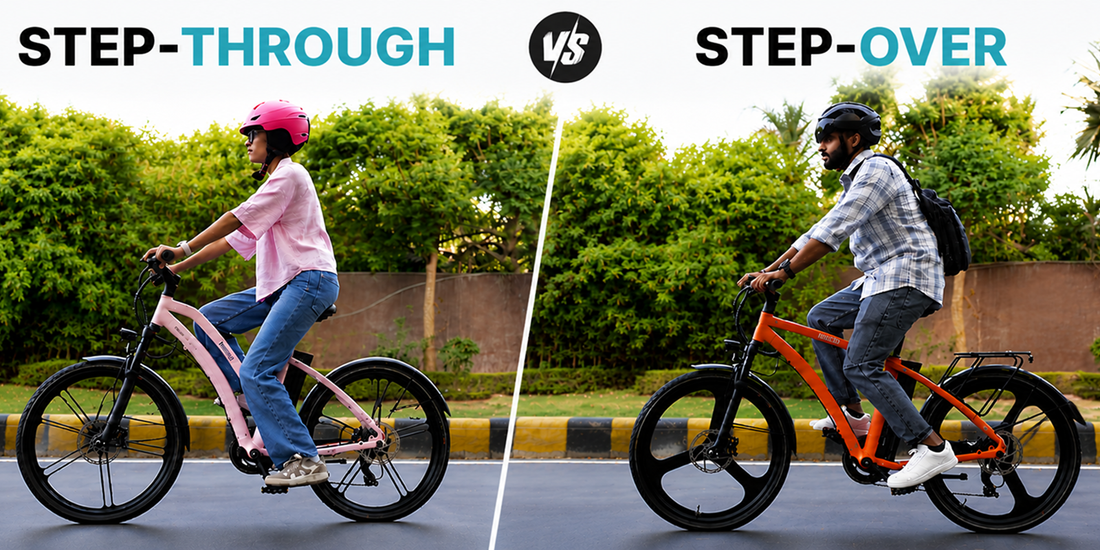
Both the NINE09 CX01 (step-over) and the NINE09 CX02 (step-through) pair a 100mm lockable front fork with 40mm seat post suspension, so neither frame style requires a comfort trade-off on rough streets.
What to Evaluate Before You Buy
Use these factors to compare suspension across different eBikes, rather than relying on a single “has suspension: yes/no” line.
| Suspension factor | What to check | Why it matters |
|---|---|---|
| Fork travel | 80 to 100mm for typical street riding | Enough to absorb potholes and curbs without unnecessarily adding trail-bike weight |
| Seat post travel | Around 40mm | Helps reduce shock reaching your back independently of the fork |
| Lock-out control | Present and easy to reach | Helps maintain a more efficient feel on smooth stretches |
| Combined coverage | Front fork and seat post | Front and rear impacts affect different parts of the ride; one component cannot fully cover both |
| Maintenance | Low-maintenance design | City riders generally want reliability without frequent suspension attention |
| Frame fit | Matches your preferred mounting style | Step-over and step-through frames provide different access and riding positions |
Common Mistakes Buyers Make When Choosing Suspension
- Assuming more travel is always better. A 120 to 150mm fork is generally more associated with trail-oriented riding and can add weight and complexity that many urban commuters do not need. On city streets, choosing suspension based on the actual road conditions is usually more useful than simply choosing the most travel.
- Ignoring the seat post. Buyers often compare fork specifications closely and forget the seat post entirely, even though it can handle a meaningful share of comfort on a daily commute.
- Not checking for lock-out. Without it, a softer suspension setup can absorb some suspension movement from your pedaling force on smooth roads, making the bike feel less responsive than it should.
- Treating suspension as a replacement for tire pressure and width. Correct tire pressure and a slightly wider tire can be an inexpensive and immediate comfort upgrade. Suspension complements this; it does not replace it.
- Buying the word “dual suspension” alone. That phrase describes a category, not a complete specification. Two eBikes can both claim dual suspension with very different actual travel and lock-out quality.
Practical Scenarios: When Suspension Pays Off
| Riding scenario | Suspension benefit |
|---|---|
| Cobblestone city center streets | High. Constant small vibrations are exactly what fork and seat post suspension are designed to help absorb. |
| Potholed side streets or tram tracks | High. Sharper, less predictable impacts benefit from both suspension travel and a responsive seat post. |
| New, smooth bike lanes | Lower, but a lockable fork means suspension can be reduced when it is not needed. |
| Frequent curb hops or raised crossings | Moderate to high, particularly for seat post comfort on a step-through frame. |
| Short, flat, well-paved commute only | Lowest, although many real-world commutes include at least some rough sections. |
Suspension and Long-Term Ownership
Suspension components on a well-built commuter eBike generally require minimal day-to-day maintenance. The main things worth checking periodically are that the lock-out lever moves freely and that the seat post suspension has not developed excessive play. Beyond that, follow the maintenance guidance provided by the manufacturer and treat suspension as a component that needs occasional inspection rather than constant attention.
Riders sometimes worry that suspension adds a failure point compared with a rigid frame. The practical trade-off depends on the components and their intended use, but for riders regularly dealing with rough urban surfaces, the additional comfort can make suspension worthwhile.
Choosing Between Step-Over and Step-Through Suspension Comfort
Because suspension travel is identical across both frame styles on models like the NINE09 CX02, your decision does not need to weigh comfort against frame type. Choose the step-over or step-through geometry based on how you prefer to mount and dismount, and expect the same fork and seat post performance on rough streets. Our guide to step-through vs. step-over eBikes walks through that choice in more detail.
If you also want a closer look at how the CX01 and CX02 differ on smart features like navigation and remote lock, the NINE09 CX01 and CX02 feature overview covers those specifics separately from frame and suspension choice.
Matching Suspension to the Streets You Actually Ride
Suspension on a commuter eBike is not about matching a mountain bike specification sheet. It is about matching your actual streets. For most city riders, a lockable front fork with 80 to 100mm of travel, paired with a seat post suspension around 40mm, provides a practical balance for potholes, cobblestones, curb cuts, and uneven pavement without adding unnecessary trail-bike capability.
For urban commuters comparing smart eBikes such as the NINE09 CX01 and CX02, suspension is one of the specifications worth understanding alongside frame design, tires, range, and other everyday riding features.
Ready to Compare Your Options?
Explore the NINE09 CX01 and NINE09 CX02 to compare their 100mm lockable front fork, 40mm seat post suspension, frame designs, and smart urban riding features.
FAQs
Do I need both front fork and seat post suspension for city riding?
Both cover different impacts. The front fork absorbs shocks through the front wheel and steering, while the seat post isolates your body weight from vertical bumps. For rough urban streets, having both can provide more complete comfort than relying on either alone.
What suspension travel is best for city riding?
For paved city streets, 80 to 100mm of front fork travel is typically enough to handle potholes, curb cuts, and uneven pavement. Trail and mountain bikes often use more travel because they face different terrain, but that extra travel adds weight and capability most urban commuters do not need.
Does a suspension lock-out feature actually matter for commuting?
Yes. Locking the fork on smooth pavement reduces suspension movement when you pedal, helping the bike feel more efficient and responsive. You can unlock it again when the road becomes rough.
Is more suspension travel always more comfortable?
Not for street riding. More travel is designed for different riding conditions and can add weight and complexity. For most urban commuters, matching suspension travel to the terrain is more important than choosing the largest travel number.
Do the NINE09 CX01 and CX02 have the same suspension setup?
Yes. Both use a 100mm lockable front fork and 40mm seat post suspension. The choice between them comes down primarily to step-over versus step-through frame preference rather than a suspension comfort trade-off.
Can good tire pressure replace the need for suspension?
No, but it helps. Correct tire pressure and appropriate tire width are important for ride comfort and work alongside suspension rather than replacing it, especially on rougher surfaces.
Does eBike suspension require extra maintenance?
Generally, suspension requires periodic inspection rather than constant maintenance. Check that the lock-out lever operates correctly and that the seat post suspension has not developed excessive play, and follow the manufacturer's recommended maintenance guidance.